
Handyman Services in Etobicoke
Builder-trained handyman services across Etobicoke — flat-rate quotes, same-week booking, and one accountable project manager on every job.
FixitPlus provides handyman services across Etobicoke, including The Kingsway, Humber Valley Village, Princess-Rosethorn, Islington Village, Eatonville, Markland Wood, Mimico, New Toronto, Long Branch, Alderwood, Rexdale and the condo towers of Humber Bay Shores and Etobicoke City Centre. We handle TV mounting, plaster and drywall repair, painting, plumbing fixtures, doors and carpentry, tile, caulking, blinds, deck and fence repairs and full to-do lists — quoted flat-rate before we start, with most jobs booked within the same week.
Handyman in Etobicoke — key facts
| Area covered | The Kingsway, Humber Valley Village, Princess-Rosethorn, Islington Village, Eatonville, Markland Wood, Mimico, New Toronto and the rest of Etobicoke |
|---|---|
| Most-requested here | Drywall & Wall Repair, Doors & Carpentry, TV & Wall Mounting, Blinds, Curtains & Windows |
| All services | 12 handyman services, plus renovations from the same company |
| Quotes | Free, no-obligation and flat-rate — agreed in writing before work starts |
| Booking | Most handyman jobs booked within the same week · Mon–Sat · 8am – 7pm |
| Licensed work | Electrical work by a licensed electrical contractor (ESA); plumbing that needs a permit by a licensed plumber; gas by a TSSA-registered gas technician |
| Cover | FixitPlus Inc. — licensed, insured, WSIB covered, workmanship guarantee |
| Who you deal with | Alan, Project Manager — one point of contact from quote to walkthrough |
| Get a quote | 416-881-2264 · info@fixitplus.ca · request a free Etobicoke quote online |
Etobicoke runs from the Lake Ontario shoreline north to Steeles, west of the Humber River, and it has been part of the City of Toronto since 1998. Inside it sits more than a century of house-building: 1920s Tudor-revival homes in The Kingsway, post-war bungalows along the lakeshore, 1960s split-levels in Markland Wood and glass towers at Humber Bay Shores. A handyman visit in Etobicoke goes well when it is planned for the house that is actually there, because the same request — a TV on the wall, a cracked ceiling, a door that will not latch — is a different job in each of them.
The Kingsway and Humber Valley Village grew out of Robert Home Smith’s plans for the land along the Humber. Kingsway Park was built mostly between the mid-1920s and the late 1940s and reads like an English garden suburb: Tudor-revival and English-cottage houses in brick and stone, stucco and half-timbering, leaded-glass casements, plaster on wood lath, arched openings and oak floors. Humber Valley Village filled in from the 1930s into the 1960s, so one street can run from a Tudor house to a Cape Cod to a ranch bungalow. West of Islington Avenue, Princess-Rosethorn was laid out after the Second World War on curving streets and crescents, with mid-century bungalows and two-storeys on wide, treed lots. In all three, repairs are careful work — plaster patched as plaster, original trim kept or matched, and old hardwood protected while we are in the room. Our page on drywall and plaster repair explains the difference.
Down on the lake, the old lakeshore towns tell a different story. Mimico boomed after the railway yard opened in the early 1900s, and New Toronto was planned as an industrial town with workers’ houses on its numbered streets, most of them built after the First World War. Long Branch, which runs west to the Etobicoke Creek border with Mississauga, and Alderwood just north of it filled in after the Second World War with modest bungalows and storey-and-a-half houses on deep lots. Those streets are now in transition. A post-war bungalow can sit beside two new houses built on a severed lot, and the work follows suit: older houses that need doors rehung, bathrooms re-caulked and drafts sealed, and new infill homes with their own settling-in repairs.
Central and northern Etobicoke is the post-war suburb in full. Islington Village was subdivided around its old Dundas Street core shortly after the war. Eatonville, on farmland the Eaton’s company once ran, was built up through the 1950s east of Highway 427 and through the 1960s and 70s west of it. Markland Wood followed in the 1960s beside its golf course on Etobicoke Creek, with grey-brick two-storeys, bungalows and split-levels on wooded lots. North of the 401, Rexdale began in the early 1950s with Rex Heslop’s bungalows and storey-and-a-half houses near the old village of Thistletown, with townhouse complexes and apartment towers following in later decades. Houses of this age produce a predictable list: loose split-level railings, closet doors off their tracks, original tub surrounds, cracked hall tile, and textured ceilings that should be tested for asbestos before anyone sands them. Some homes from the late 1960s and 1970s also have aluminum branch wiring — and in any Etobicoke house, electrical work is done by a licensed electrical contractor, not by us.
Then there is the Etobicoke that went up rather than out. The towers of Humber Bay Shores replaced the motels that once lined Lake Shore Boulevard between Park Lawn and the mouth of the Humber, and the Etobicoke City Centre condos around Islington and Kipling stations and the rebuilt Six Points junction keep adding more. Condo work here means concrete ceilings and columns, metal-stud partitions, floor-to-ceiling window walls and a management office that sets the drilling hours, books the service elevator and usually asks for a contractor’s certificate of insurance. We are licensed, insured and WSIB covered, and we send that paperwork ahead so the visit is not held up at the front desk.
Across all of it, plenty of Etobicoke houses are at a crossroads: keep and renovate, or rebuild. FixitPlus came out of custom-home building — new builds, additions and whole-home renovations — so we can talk honestly about both, and keep the house you have working properly in the meantime. Whether you need a single home repair in Etobicoke or a list that has been growing for a year, Alan, our project manager, is the single point of contact from the first quote to the final walkthrough, and the whole list is quoted flat-rate before anyone picks up a tool.
Where we work in Etobicoke
Not on the list? We cover the whole Greater Toronto Area — call and we will tell you straight away.
What Etobicoke homeowners call us for
Plaster, arches and coves in Kingsway-era houses
Houses from the 1920s to the 1940s in The Kingsway and Humber Valley Village have plaster on wood lath, arched openings and curved ceiling edges. Cracks are keyed, filled and finished as plaster, and curves are shaped by hand rather than squared off with drywall bead, so the room keeps its lines.
Casement windows that stick or draft
Original wood casements, many with leaded glass, are worth keeping. We free painted-shut sashes, adjust worn hinges and stays, and renew weatherstripping and exterior caulk. Cracked leaded panels and sagging lead cames are work for a stained-glass specialist, and we say so rather than improvise.
Storey-and-a-half bedrooms under the roof
Post-war storey-and-a-half houses in Long Branch, Alderwood and Rexdale put the bedrooms upstairs under sloped ceilings. Those slopes crack where they meet the walls, the small knee-wall hatches leak cold air, and dormer windows are awkward to dress. We patch the cracks, fit and weatherstrip the hatches and hang blinds that clear the slope.
Shaded decks and patio doors in Markland Wood
Big trees on Markland Wood and Humber Valley lots keep decks and fences in shade and slow to dry. We replace soft boards, re-fasten loose railings, re-set leaning posts and rehang gates, and bring sliding patio doors back with new rollers, a cleaned track and fresh weatherstripping.
Window-wall blinds at Humber Bay Shores
Floor-to-ceiling glazing in the lakefront towers leaves the ceiling or a drywall bulkhead as the place to fix a blind or curtain track, since in many buildings the window frame is part of the common elements. We check what each bulkhead hides, anchor properly into concrete and keep well clear of sprinkler lines.
Settling-in repairs in new infill homes
New houses on severed lots in Long Branch, Mimico and Alderwood go through the same drying-out period as any new build: fastener pops, hairline cracks at the corners of openings, tall doors that start to rub and caulk joints at glass showers that open up. If the house is still under its new-home warranty, start with the builder; otherwise we handle the list in one visit after the first heating season.
Handyman services in Etobicoke
Every handyman service is available in Etobicoke:
Ready to book? Request a free Etobicoke quote or call 416-881-2264 — send the whole list and we quote it as one visit.
Work you can actually look at
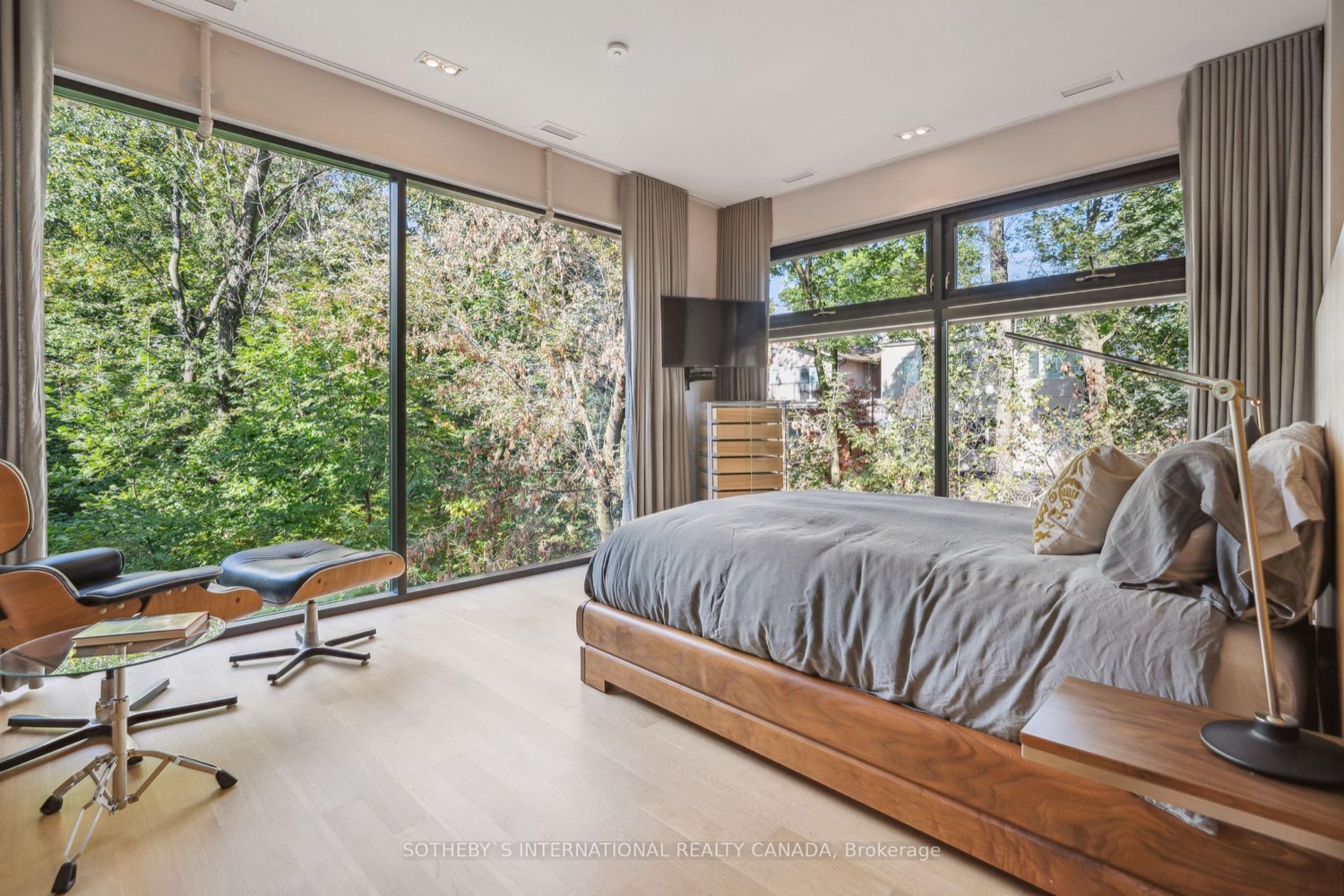
Our Lawrence Park project is a full renovation of a dated Toronto house — floor-to-ceiling glass, walnut feature walls, a floating dining bench and a hotel-grade primary bath. It is in Lawrence Park, midtown Toronto, not Etobicoke. We point to it because owners in The Kingsway, Humber Valley Village and Princess-Rosethorn weigh the same renovate-or-rebuild question with an older house, and because it shows the finish standard the same team brings to an Etobicoke handyman visit.
Keeping the character in a 1920s–50s Etobicoke house
The houses laid out along the Humber between the 1920s and the 1950s were built with a level of detail that is expensive to reproduce today: plaster walls, solid panel doors, wood casements, oak floors and trim with real depth. Most of what wears out in them can be repaired rather than replaced, and repairing it keeps the thing that made the house worth buying in the first place.
The same thinking applies to a 1950s Princess-Rosethorn bungalow or an Islington Village Cape Cod. Original oak floors and simple, well-proportioned trim are worth keeping, and a repair that matches them disappears where a modern substitute would stand out.
None of this means everything old should stay. Single-pane windows, worn-out bathrooms and wiring at the end of its life are often better replaced — wiring by a licensed electrical contractor, bigger changes as a renovation we scope properly. The point is to decide item by item, not by default. Here is where we start.
Plaster before drywall
A cracked plaster wall rarely needs to come down. Loose sections are re-attached to the lath, cracks are keyed and filled, and the surface is skimmed to match. Swapping a whole wall for drywall changes its thickness at every casing and outlet, and that difference then has to be disguised.
Doors and hardware
Original panel doors usually stick because hinges have worn or the frame has moved, not because the door is bad. We tighten or shim the hinges, ease the edge only as much as needed, and keep old mortise locks and knobs working wherever they can be.
Trim matched, not swapped
When a run of baseboard or casing has to be replaced, we match the existing profile, combining stock mouldings or having a piece milled, so the new section reads as part of the original room.
Casements and leaded glass
Sticking sashes, worn hinges and failed weatherstripping are handyman work. Cracked leaded panels and bowed cames go to a stained-glass specialist. Keeping the original frames working is almost always possible.
Oak floors and thresholds
Squeaks are fixed from below where the basement ceiling is open, or with concealed screws from above. Damaged boards are replaced with matching oak and blended in, and worn thresholds are replaced in hardwood rather than metal strips.
Handyman in Etobicoke — common questions
Yes. Our coverage runs from Ajax to Oakville, and Etobicoke sits inside it end to end: Long Branch, New Toronto and Mimico on the lake; The Kingsway, Humber Valley Village, Islington Village and Princess-Rosethorn in the middle; Eatonville, Markland Wood and Alderwood in the west; and Rexdale and Thistletown in the north. Most handyman jobs book within the same week, with a real arrival window rather than a vague day.
Yes, as plaster. Where plaster has pulled away from the lath — it sounds hollow and flexes when pressed — we re-attach it with plaster washers before any filling. Cracks are opened, bonded and filled with setting compounds, then skimmed to match the wall around them. Done this way, the repair holds through the seasonal movement these houses still go through instead of reappearing along its edges a winter later.
Yes. On plaster and lath, stud finders are unreliable, so we confirm the framing with small test holes and fasten through to it. On a brick chimney breast or masonry wall, anchors go into solid brick rather than mortar joints. Running cables inside an old wall is slower because of blocking and hidden obstructions, so a surface raceway is sometimes the better answer. A new outlet behind the TV is electrical work for a licensed electrical contractor.
Yes. Expect concrete ceilings and columns, metal-stud partitions, window walls, set drilling hours and a booked service elevator. Many management offices want a contractor’s certificate of insurance before they confirm a booking; we are licensed, insured and WSIB covered and send it ahead. What you may drill into, and when, is set by your declaration and rules — check them or ask management, and send us whatever they give you.
A few things change who does the work. Knob-and-tube wiring in pre-war houses and aluminum branch wiring in some late-1960s and 1970s homes are for a licensed electrical contractor. Textured ceilings, some plaster finishes and vermiculite attic insulation from past decades can contain asbestos, and paint in houses built before the 1960s can contain lead, so we recommend testing before anything is sanded, scraped or opened up. None of it is unusual; it just needs handling properly from the start.
No. In Ontario, anyone paid to do electrical work must be a Licensed Electrical Contractor, so fixtures, pot lights, switches, outlets and fans are done by a licensed electrical contractor. We coordinate that work as part of a larger list and handle what comes after it — patching the plaster or drywall around a new box and painting it so the repair disappears into the wall.
Yes — pre-listing work suits a single flat-rate visit. Typically that means patching and painting scuffed walls, re-caulking tubs and showers, adjusting doors that stick, replacing tired cabinet and door hardware, re-securing a loose railing and tidying the deck or fence. Tell us your listing date and your agent’s list, and we work through it in priority order so the house is ready for photos.
Call 416-881-2264, email info@fixitplus.ca or use the quote form, and send photos and the list if you can. We reply with a flat-rate quote for the whole visit, agreed before any work starts, and most handyman jobs book within the same week. We work Monday to Saturday, 8am to 7pm. If something is urgent, such as a leak or a door that will not lock, say so and we will prioritize it.

Alan
Project Manager, FixitPlus Inc.
Scope and technical detail on this page is set by Alan, FixitPlus project manager, drawing on 20+ years of custom-home building in the GTA. Where a job legally requires a licensed trade or a permit, we say so on the page rather than in the small print.
- 20+ years of custom-home building across the GTA
- Project manager on new builds, additions and whole-home renovations
- Single point of contact on every FixitPlus job
Last reviewed
Nearby cities we cover
Handyman Mississauga
Port Credit, Lorne Park, Mineola, Clarkson and across Mississauga.
Mississauga pageHandyman North York
Willowdale, Bayview Village, Don Mills, York Mills and across North York.
North York pageHandyman Downtown Toronto
CityPlace, Fort York, Liberty Village, King West and across Downtown Toronto.
Downtown Toronto pageNeed a handyman in Etobicoke?
Send the whole list and get one flat-rate quote — usually back within a business day.