
Handyman Services in Downtown Toronto
Builder-trained handyman services across Downtown Toronto — flat-rate quotes, same-week booking, and one accountable project manager on every job.
FixitPlus provides handyman services in downtown Toronto for condos and older homes — CityPlace, Fort York, Liberty Village, King West, Harbourfront, St. Lawrence, the Distillery District, Regent Park, Yorkville and Church–Wellesley, plus the Victorian streets of Cabbagetown, Corktown, Trinity-Bellwoods, Little Italy and The Annex. We handle TV mounting on concrete and metal stud, drywall and plaster repair, blinds, furniture assembly, doors, caulking, painting and to-do lists, with building paperwork sorted before the visit and a flat-rate quote agreed before we start.
Handyman in Downtown Toronto — key facts
| Area covered | CityPlace, Fort York, Liberty Village, King West, Harbourfront, St. Lawrence, Distillery District, Regent Park and the rest of Downtown Toronto |
|---|---|
| Most-requested here | TV & Wall Mounting, Blinds, Curtains & Windows, Furniture Assembly, Drywall & Wall Repair |
| All services | 12 handyman services, plus renovations from the same company |
| Quotes | Free, no-obligation and flat-rate — agreed in writing before work starts |
| Booking | Most handyman jobs booked within the same week · Mon–Sat · 8am – 7pm |
| Licensed work | Electrical work by a licensed electrical contractor (ESA); plumbing that needs a permit by a licensed plumber; gas by a TSSA-registered gas technician |
| Cover | FixitPlus Inc. — licensed, insured, WSIB covered, workmanship guarantee |
| Who you deal with | Alan, Project Manager — one point of contact from quote to walkthrough |
| Get a quote | 416-881-2264 · info@fixitplus.ca · request a free Downtown Toronto quote online |
Downtown Toronto is two kinds of handyman work sharing the same postal codes. One is the condo: a suite in a concrete tower where the building decides when you can drill, how the crew gets upstairs and where the van parks. The other is the house: a Victorian or Edwardian row house or semi on a narrow lot, with plaster walls, a steep stair and floors that have been settling for more than a century. FixitPlus works in both. In a condo, most of the job is planning; in an old house, most of it is knowing what is behind the wall.
The condo side covers most of the core: CityPlace and Fort York beside the rail corridor, Harbourfront along Queens Quay, King West and Liberty Village on old industrial land, the St. Lawrence neighbourhood and the Distillery District to the east, the rebuilt Regent Park, and the towers around Yonge and Bloor, Yorkville and Church–Wellesley. Most of these suites share a construction method: poured concrete ceilings, columns and some walls; light-gauge metal studs for the partitions; drywall bulkheads hiding ductwork and sprinkler lines; and floor-to-ceiling window walls. Each surface takes a different anchor, and some of them may need the building’s permission before anyone drills.
In a condo, the building sets the terms of the visit, and good condo handyman work in Toronto is mostly done before anyone arrives. Many management offices ask for the contractor’s certificate of insurance before they confirm anything; we are licensed, insured and WSIB covered and send it ahead. The service elevator usually has to be booked, and month-end move-ins and move-outs fill the calendar quickly. Drilling and other noisy work is limited to set hours. Deliveries such as flat-pack furniture may wait in the parcel room or at the concierge desk, and trades parking is often a booked visitor space or a short spell at the loading dock. Your declaration and rules govern all of it — when in doubt, ask management.
Not every downtown suite is new. Some towers around Church–Wellesley, St. Lawrence and Yonge and Bloor date back decades, and textured ceilings in older buildings should be tested for asbestos before they are patched or sanded. The hard lofts of King West and Liberty Village — former factories and warehouses converted to homes — trade drywall for brick, timber beams and exposed concrete, where the right fastener depends on whether you hit solid brick or a soft mortar joint. Soft lofts, newer buildings designed to look industrial, leave ducts and sprinkler pipe exposed on the concrete ceiling, which limits where anything can hang.
The other downtown is older than any tower. Cabbagetown holds one of the largest stretches of Victorian housing in North America, from small Ontario workers’ cottages to ornate bay-and-gable houses. Corktown, Trinity-Bellwoods, Little Italy and Kensington Market are streets of Victorian and Edwardian row houses and semis, and The Annex is known for its big late-19th-century houses in brick and stone. Inside, expect plaster on wood lath, and on many outside and party walls plaster laid straight onto the brick; tall baseboards and deep casings; softwood floors that slope toward the middle of the house; stairs so steep and narrow that a box spring may not make the turn; and doors hung in openings that went out of square generations ago.
Older houses also hide work that belongs to licensed trades. Knob-and-tube wiring survives in some walls, and all electrical work — down to a single outlet or light fixture — is done by a licensed electrical contractor; we coordinate it and patch and paint afterwards. Old galvanized or lead water lines and cast-iron drains go to a licensed plumber, while faucet and toilet swaps on working shut-offs are ours. Parts of Cabbagetown and other older neighbourhoods are heritage conservation districts, where changes to the street-facing exterior can need a heritage permit, so check with the City before replacing a porch, front door or window. Planning something bigger in a suite? Our guide to condo renovation in Toronto covers approvals and permits. If you are outside the core, our handyman services across Toronto and the GTA work the same way.
Where we work in Downtown Toronto
Not on the list? We cover the whole Greater Toronto Area — call and we will tell you straight away.
What Downtown Toronto homeowners call us for
TV mounts on concrete and metal stud
Concrete takes a hammer drill and masonry anchors rated for the load; a metal-stud partition takes heavy-duty toggles, ideally through a stud. We confirm which wall is which before quoting, run cables in a slim paintable raceway where they cannot go inside the wall, and drill only within your building’s permitted hours.
Blinds and tracks on window walls
Floor-to-ceiling glazing leaves nowhere to fix a bracket except the ceiling or a bulkhead. We find out what the bulkhead hides before drilling, keep clear of sprinkler lines and heads, and follow any building rule on the colour or lining that faces outside.
Flat-pack from the parcel room
Beds, wardrobes and desks delivered to the concierge or parcel room, carried up in the booked elevator, built in the room they are for and anchored to concrete or metal stud — with the cardboard broken down and taken away rather than left for the garbage room.
Caulk in windowless condo bathrooms
Interior condo bathrooms depend on the exhaust fan, and the caulk at the tub, the shower glass and the vanity top is usually the first thing to fail. We cut it out, dry the joint and re-seal with a mould-resistant product. If water may be getting through to the suite below, tell management before anything is opened up.
Plaster and tall trim in Victorian houses
Plaster on lath, and plaster laid straight onto brick, repaired as plaster in Cabbagetown, Corktown and Trinity-Bellwoods houses. Damaged runs of tall baseboard and deep casing are replaced to match the profile already in the room rather than with modern stock.
Doors in openings that are not square
Settled floors pull door frames out of square in older downtown houses. We shim and reset hinges, scribe and plane doors to the opening they actually have, and adjust strikes so they latch — and fit a new door by hand when the old one cannot be saved.
Handyman services in Downtown Toronto
Every handyman service is available in Downtown Toronto:
Ready to book? Request a free Downtown Toronto quote or call 416-881-2264 — send the whole list and we quote it as one visit.
Work you can actually look at
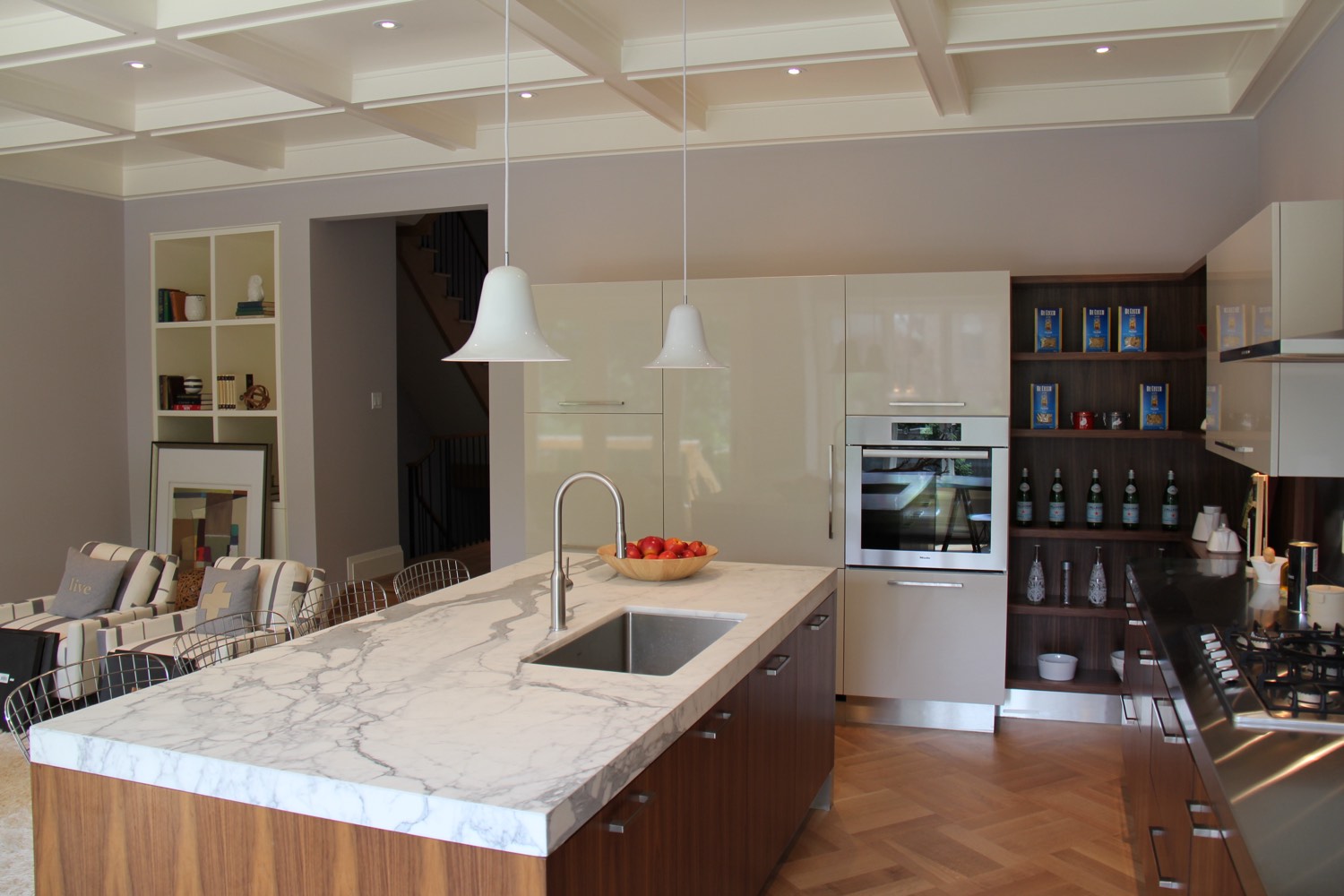
Our Moore Park project is a custom new build in Moore Park, midtown Toronto — a marble waterfall island, custom cabinetry and rich, tactile materials throughout. It is not downtown, and we will not pretend it is. We point to it because it is a real Toronto home we built and documented in full, and it shows the finish standard the same team brings to a downtown condo suite or Victorian row house.
The downtown condo move: what to fix on each side of it
Downtown suites change hands often — new owners, renters coming and going, investors turning a unit over between leases — and the same short list of jobs comes up at every move. Most of these condo repairs are quick work. The friction is the building: one elevator booking, a set drilling window and a concierge who needs to know we are coming.
That is why we suggest folding the list into a single visit timed around the move, rather than scattering it across the first month. Here is what typically comes up at each end of a downtown move.
If you rent, check with your landlord before drilling, mounting or painting, because many leases and buildings set their own expectations. If you own the suite and rent it out, we can work from photos and a list, with access arranged through management or the concierge where the building allows it.
Before you hand back the keys
Anchor holes from TVs and shelves filled and sanded flat, scuffed walls touched up — or a whole wall repainted where touch-ups would show a different sheen — closet doors back on their tracks, and failed caulk at the tub cut out and renewed.
The week you move in
Furniture built in the room and anchored, blinds or curtain tracks up before the first sunrise through a window wall, the TV mounted at the right height, and hooks, door stops and closet shelving where you actually need them.
Between tenants
A turnover list for rented suites: patch and paint, re-caulk, replace worn closet hardware and blinds, and a written note of anything that looks like the corporation’s to fix, such as a balcony door or a window-wall seal, so you can raise it with management.
Small-suite storage that holds
Floating shelves on metal stud with proper toggles, wall-mounted desks, closet systems and over-door storage — the pieces that make a compact suite work, fixed so they stay level and secure.
Handyman in Downtown Toronto — common questions
Yes. FixitPlus is licensed, insured and WSIB covered, and many downtown buildings ask for a contractor’s certificate of insurance before they confirm an elevator booking or let trades in. Some also ask for proof of WSIB coverage or have specific wording requirements. Send us management’s requirements or the property manager’s contact details, and we send our paperwork ahead of the visit so nobody is held at the concierge desk.
In many buildings the booking has to come from the resident, through management or the building’s booking system. Book a window that covers our arrival, the work and the clean-up, and tell us the time and any loading-dock instructions. In some buildings a short job such as a TV mount or blinds can use a regular elevator with padding, but that is management’s call, not ours — check before the day.
Your building sets them. Drilling and other noisy work is usually limited to daytime hours, often on weekdays only, and some buildings restrict or ban it on weekends and holidays. Check your rules or ask management. Quieter jobs such as furniture assembly, caulking and painting may be allowed outside the drilling window, so we do the noisy work first and the quiet work after.
It depends on your declaration, your corporation’s standard unit by-law if it has one, and where the problem started. Generally, finishes inside the suite are the owner’s, while the structure, window walls, balconies and shared pipes and risers are common elements. After a leak from above or from a building pipe, report it to management first and leave the damage until the corporation and any insurer have seen it. Once responsibility is clear, we can do the drywall, paint and caulk.
Often, but check first. Many buildings restrict drilling into the ceiling slab or require approval, because some slabs contain post-tensioned steel tendons and conduit can run through them. Curtain tracks, ceiling hooks and projector mounts need the building’s okay; light fixtures go on the existing box and are installed by a licensed electrical contractor. Check your declaration and rules or ask management, and we work within whatever they allow.
Yes. Expect us to repair plaster as plaster, fit doors to openings that are no longer square, match tall baseboard and casing profiles, and re-secure loose handrails and spindles on narrow stairs. Flat-pack furniture that will not make the turn on a steep stair gets built in the room. If we open a wall and find knob-and-tube wiring, that part goes to a licensed electrical contractor before we continue.
Often, yes. Sashes painted shut can be cut free, worn stops and parting beads replaced, and — where the weight pockets can be opened — broken sash cords renewed so the counterweights hold the window where you leave it. Fresh weatherstripping and exterior caulk cut drafts. Rotten sills, broken glass in old sashes or a full restoration may need a window specialist, and we will tell you when it does.
Downtown, parking is part of the plan, not an afterthought. In a condo, ask management whether a visitor space or the loading dock can be booked for trades, and for how long. For a house, tell us about rear-lane access, a parking pad or permit parking on the street. We plan the visit around what is available, so time on site goes into the work rather than circling the block.
Not as handyman work. Pot lights, new fixtures, outlets and any other electrical work are done by a licensed electrical contractor, and in a concrete ceiling they usually need the building’s approval too. Kitchens, bathrooms and changes to flooring are renovation projects that we plan through our renovations side, often with corporation approval and permits. Our condo renovation guide on the blog walks through how that works.

Alan
Project Manager, FixitPlus Inc.
Scope and technical detail on this page is set by Alan, FixitPlus project manager, drawing on 20+ years of custom-home building in the GTA. Where a job legally requires a licensed trade or a permit, we say so on the page rather than in the small print.
- 20+ years of custom-home building across the GTA
- Project manager on new builds, additions and whole-home renovations
- Single point of contact on every FixitPlus job
Last reviewed
Nearby cities we cover
Handyman North York
Willowdale, Bayview Village, Don Mills, York Mills and across North York.
North York pageHandyman Etobicoke
The Kingsway, Humber Valley Village, Princess-Rosethorn, Islington Village and across Etobicoke.
Etobicoke pageHandyman Scarborough
Agincourt, Wexford, Dorset Park, Guildwood and across Scarborough.
Scarborough pageNeed a handyman in Downtown Toronto?
Send the whole list and get one flat-rate quote — usually back within a business day.